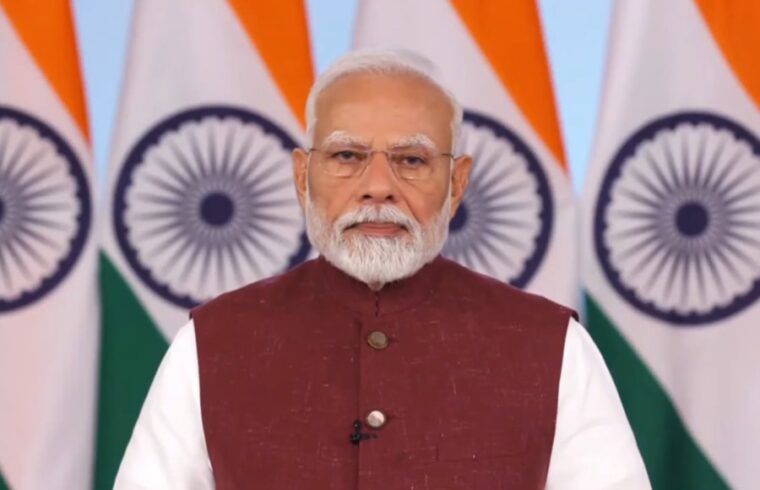
Addressing the nation on May 12, 2025, in the wake of Operation Sindoor, Prime Minister Narendra Modi emphatically said that India will not tolerate Pakistan’s nuclear blackmail through which it has been promoting terrorism in India.
Modi emphasised that in the aftermath of the brutal Pahalgam attacks, in which terrorists had segregated and identified Hindu tourists before killing them in front of their families on April 22, India, through Operation Sindoor had inflicted considerable damage on terror infrastructure in Pakistan and Pakistan-Occupied Kashmir (PoK). The operation was significant as India attacked terror training camps in Pakistan for the first time in more than 50 years. Previously, in the two surgical strikes in 2016 and 2019, India had only struck terror bases inside PoK.
Underlining Operation Sindoor as a new normal in India’s counter-terrorism strategy, the Prime Minister that the operation destroyed terrorist infrastructure including Pakistan military airbases and training facilities. He stressed that India will show zero tolerance towards terrorism and future discussions with Pakistan would only focus on curbing terrorism and the future of PoK.
Modi said that with Operation Sindoor, India’s security doctrine has undergone a massive shift. He said that the three principles of security doctrine will be that any terror attack on India will be met with a resolute response; the second principle will be that India will no longer be blackmailed by nuclear threats; and the third principle will be that India will not distinguish between terror leaders and governments supporting them. Modi said: “India will no longer see terrorist leaders and governments sheltering them as separate entities. During Operation Sindoor, the world witnessed Pakistan’s reality where senior Pakistani military officials were openly attending funerals of eliminated terrorists, proving Pakistan’s involvement in state-sponsored terrorism”.
In his address to the nation, Modi highlighted that India agreed to a ceasefire only after the Pakistan Director General of Military Operations (DGMO) rang up his Indian counterpart and spoke about stopping the operations. Modi said that by then India had inflicted heavy damage on Pakistan’s terrorism infrastructure which was beyond Pakistan’s imagination. Indian strikes had caused so much panic that Pakistan had to turn to the international community pleading it to ask India to cease the military operations.
Highlighting the role of Pakistan in promoting terror from its soil, Modi cleverly mentioned that in incidents like the 9/11 terror attacks in the US, the Tube bombings in the UK, and in other global attacks, Pakistan’s terror industry had a hand. He said that Indian precision weapons struck terror hubs like Muridke and Bahawalpur which are universities for promoting and spreading terror.
So, why did the Indian military strike Muridke and Bahawalpur under Operation Sindoor? Besides being large bases for Pakistan’s terror organisations, these two areas lie in Pakistan’s most pampered province – Punjab. Attacking Pakistan’s Punjab is like slicing the heart of Pakistan. Striking at the root of Pakistan’s terror factories is a signal to the international community that terror organisations inimical to India thrived in Pakistan despite the expensive two-decade War on Terror. The Indian military strikes hit at Hizb-ul-Mujahideen (HM), Jaish-e-Mohammed (JeM) and Lashkar-e-Taiba (LeT) camps in both Pakistan’s Punjab and PoK.
Expressing surprise at Pakistan’s intransigence, Modi highlighted that instead of helping India apprehend the terrorists behind the Pahalgam attacks, Pakistan instead doubled down on India and launched attacks on the country. However, these attacks on Indian civilian and military infrastructure were disabled with India’s modern weaponry, he said.
The Indian Prime Minister said that trade and terror will not go together. Referring to a likely future water dispute between India and Pakistan arising out of the Pahalgam attacks, Modi said that water and blood will not flow together.
Significantly, the Indian response to the Pahalgam terror strike has been unprecedented and led to fears in the international community that it could lead to a full-blown war. India has not been a stranger to deadly terror strikes from Pakistan which have enveloped almost the entire western length of the country – the Mumbai serial bomb blasts and the Mumbai terror attacks, to terror incidents in Gujarat temples, to bombing markets in Delhi, and targeted killings of minority Hindus and Sikhs in Jammu & Kashmir. However, Operation Sindoor has been India’s most decisive and resolute counter-terror that went beyond mere diplomatic sanctions and appeals to the US and multilateral agencies.
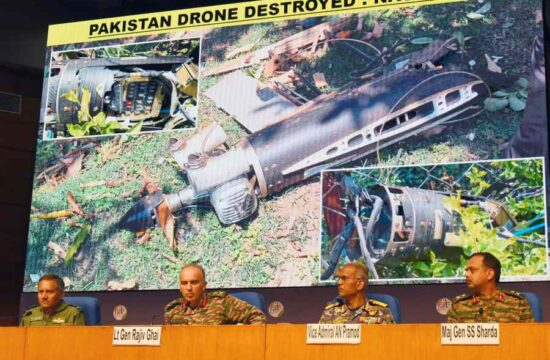
With Operation Sindoor, a joint press conference by generals of the three forces and the address to the nation by Prime Minister Narendra Modi, India seems to have sent a unified message to not just Pakistan and its terror arms but the world to pressure a rogue nation and rein in its terror machinery.