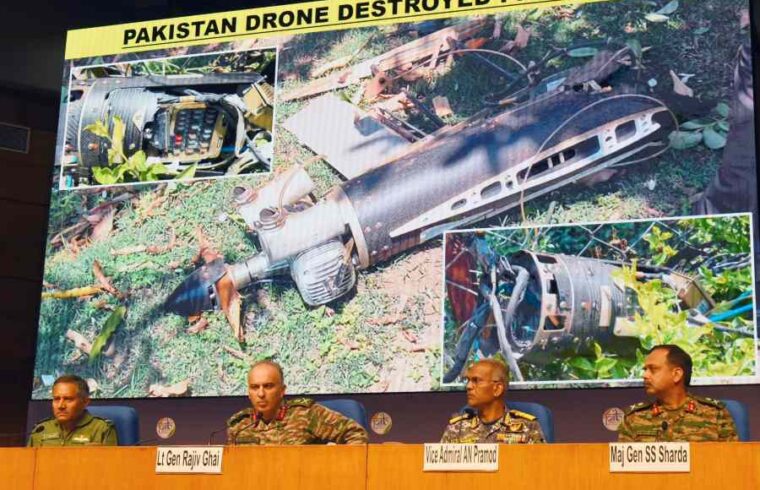
Funnily, the New York Times and the Indian right (often lovingly referred to as the right-wing Hindutva nationalists by the Western media and the Left) find themselves together on the million-dollar question: did India, inadvertently or otherwise, bomb the Nur Khan Air Base in Rawalpindi — the headquarters of the mighty Pakistani Army? The precision strikes sparked panic in Islamabad that ricocheted across Washington, forcing the otherwise disengaged but mercurial US President Donald Trump to broker an agreement between a furious India and a worried Pakistan.
With these precision strikes, the Islamic republic — known for its checkered history of military and military-dictated civilian rule — lost the nuclear edge it had used to hold India hostage for decades, repeatedly getting away with crimes against humanity.
The precision attack on Rawalpindi is significant in more ways than one.
India’s strikes have effectively turned the nuclear tables on Pakistan. The blackmail and deterrence narrative has been busted. It also introduces a new dimension: instead of India being the presumed first target of nuclear annihilation, it can be Pakistan, that too without an external nuclear attack. Pakistan could now be vulnerable to devastation, not from an external nuclear attack, but as a result of a precise conventional strike by India that triggers its own nuclear arsenal. I am not an expert in weaponry, and certainly not in nuclear warfare, so I leave that scenario to the experts. It is exactly this possibility that caused Washington to sit up and take notice.
Washington feared that Indian ammunition may have struck dangerously close to where some of Pakistan’s nuclear weapons are stored, raising concerns of a potential nuclear Armageddon in the Indian subcontinent. Ironically, this time the fear was reversed: not that Pakistan might nuke India, but that its larger, more restrained neighbor might strike close to Pakistan’s nuclear stockpiles. Social media spiraled into a frenzy with claims of ‘cooking nukes under Pakistani soil causing earthquakes’ and reports of Egyptian and American radiation detection planes hovering over Pakistani airspace. The world was worried.
The strikes on the Nur Khan Air Base, the Malir Cantonment near Karachi, and targets in Lahore and Gujranwala effectively flipped the nuclear narrative. Suddenly, Pakistan felt exposed, and its military appeared farcical. That said, the Pakistani public still rallied behind the army, much as it did during the soul-crushing 1971 defeat, that created history with the birth of Bangladesh.
The Operation Sindoor strikes on Pakistan’s terror nurseries and military bases channeled the rightful anger over the brutal Pahalgam killings straight to General Asim Munir’s home turf in Rawalpindi, taking the Pakistani Army by surprise. It served as a wake-up call: misadventures by either home-grown terrorists or the army itself can reverberate in Islamabad—just a stone’s throw from Rawalpindi. Politically, this may not dent Munir’s position as the de facto ruler, given that he propped up Prime Minister Shehbaz Sharif. But as the dust settles, questions will be raised about his recklessness in pushing Pakistan into a dangerous confrontation with India, where nukes, its biggest deterrent and pride possessions, were under attack and its pet threat snatched like a toy from a petulant child.
General Asim Munir’s miscalculation has also brought into focus his hate speech against India and Hindus at the Overseas Pakistanis Convention in Islamabad on April 16, where he is believed to have dog-whistled the killing of Hindu tourists in Pahalgam through the terror group, The Resistance Front (TRF).
While hate rhetoric may resonate well with the domestic audiences—including among non-resident Pakistanis, it undermines Pakistan’s international standing. An unstable, war-mongering country is hardly a magnet for the investment its military-backed government seeks. Despite Pakistani advertisements aired on local UK radio stations and billboards inviting investment in the Gwadar port and its associated industrial and export zones, the response from the diaspora has been underwhelming. Most non-resident Pakistanis scoff at investing in Gwadar, largely due to the Baloch insurgency. They also suspect, perhaps rightly, that their money would be siphoned off by corruption. The low level of diaspora investment in Balochistan underscores the failure of the Pakistani state and Chinese infrastructure efforts.
To sum up: Pakistan and its military lost more than they bargained for with the Pahalgam terror attack. India retaliated with force, destroying terror camps and reportedly eliminated up to 100 terrorists, their relatives, and sympathisers. More importantly, it sent a decisive diplomatic message: India’s historically weak and vague response towards Pakistan-backed terrorism is over. And the biggest takeaway? India has punctured Pakistan’s long-standing nuclear bogey.